
The New Definition of a “Smart” Structure
For years, the term “smart structuring” in international corporate planning was often a euphemism for minimizing tax liabilities by routing profits through low-tax, “tax-friendly” jurisdictions. The primary metric of success was the effective tax rate. Today, in the wake of the OECD’s BEPS project and a global surge in transparency rules, that definition has been rendered obsolete. The real competitive advantage no longer lies in finding the path of least tax resistance but in building corporate structures that are demonstrably efficient, exceptionally well-governed, and grounded in tangible operations.
As transparency rules like the Common Reporting Standard (CRS) and public beneficial ownership registries redefine cross-border planning, the focus has shifted from secrecy to sustainability. A modern, “smart” structure is one that can withstand the scrutiny of tax authorities, regulators, and the public alike. This requires a holistic approach that balances compliance with operational efficiency and fiscal optimization. This article compares frameworks across key regions, identifies the primary drivers for maintaining compliant and functional entities, and outlines how businesses can achieve this balance in a post-BEPS world.

This information advantage allows them to challenge structures that lack a clear commercial rationale or fail to meet economic substance requirements. A structure that looks good on paper but cannot be defended in practice is no longer smart; it is a significant liability.
The Old Playbook vs. The New Reality: A Paradigm Shift
The old playbook for international structuring relied on a toolkit that is now largely defunct or high-risk:
- Brass Plate Companies: Establishing entities in jurisdictions with no employees, no office, and no real activity beyond a mailing address.
- Aggressive Transfer Pricing: Using artificial intercompany transactions to shift profits from high-tax to low-tax jurisdictions, disconnected from where value was actually created.
- Complex, Opaque Layers: Creating convoluted chains of holding companies and intermediary entities to obscure ultimate beneficial ownership and frustrate tax auditors.
The new reality is one of radical transparency, where tax authorities have unprecedented access to information.

Corporate Law Considerations
Legal Vehicles: Evaluate the suitability of available structures (LLC, IBC, Foundation, Trust, Partnership) for governance flexibility, profit distribution, and shareholder arrangements.
Disclosure Requirements: Identify which information is publicly registered (directors, shareholders, annual accounts) and how this aligns with desired confidentiality levels, including UBO registry obligations.
Judicial Security and Enforcement
Regulatory Predictability: Assess legal system stability and the role of stare decisis principles in common law or civil law equivalents.
Audit Obligations: Verify the thresholds triggering statutory audits.
Economic Substance and Effective Management
Substance Requirements: Determine compliance with OECD‑aligned standards that require:
- Conducting Core Income‑Generating Activities (CIGAs) within the jurisdiction.
- Maintaining adequate local operating expenditure, qualified employees, and physical presence (offices).
Central Management and Control: Ensure that the entity’s mind and management reside locally meaning strategic decisions are made and controlled from within the jurisdiction, typically by resident directors. This is vital to establish tax residency and avoid Permanent Establishment exposure.
The Core Pillars of Modern Corporate Structuring
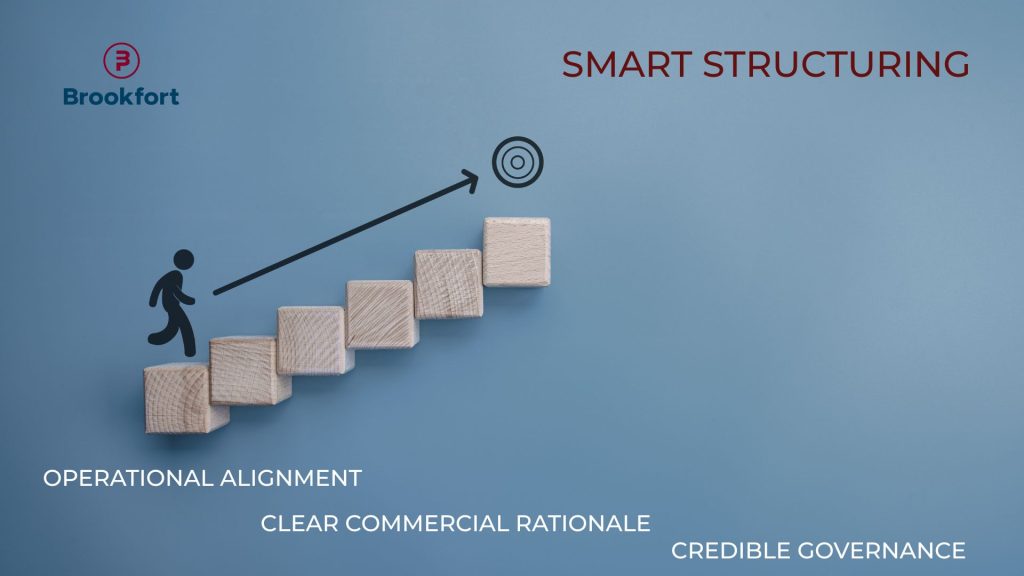
A sustainable and defensible international structure is built on three interconnected pillars: operational alignment, credible governance, and commercial rationale.
At the heart of modern transfer pricing and anti-avoidance rules is the principle that profits must be taxed where value is created. This requires a deep understanding of a company’s value chain. A “functional analysis” is the critical first step, identifying which entities within a group perform key functions, own significant assets, and assume material risks (the “FAR” analysis). The legal and tax structure must then align with this operational reality. For example, if the key strategic decisions and R&D functions for a product line are based in Spain, a significant portion of the resulting profits should be allocated there, even if the intellectual property is legally held by a subsidiary in Luxembourg. An efficient structure streamlines operations and ensures that profit allocation is defensible under the arm’s length principle.
Strong corporate governance is no longer a “soft” issue but a hard requirement for compliance. Regulators need to see that an entity is genuinely managed and controlled from its claimed jurisdiction of residence. This goes beyond the substance tests discussed previously and touches on the quality of oversight. A credible governance framework includes:
- An independent and engaged board of directors with the right mix of skills.
- Robust internal controls and risk management processes.
- Clear documentation of all significant corporate decisions.
- Ethical conduct and a culture of compliance that permeates the organization.
Good governance enhances a company’s reputation, builds trust with stakeholders, and serves as the first line of defense against regulatory challenges.
Every entity and every significant transaction within a corporate group must have a clear business purpose beyond obtaining a tax advantage. When challenged by a tax authority, a company must be able to answer the question: “Why is your structure set up this way?” If the only compelling answer is tax reduction, the structure is unlikely to withstand scrutiny. Commercial rationales can include market entry, supply chain optimization, risk diversification, access to specialized labor pools, or the centralization of administrative functions. This rationale should be clearly articulated and documented before the structure is implemented.
A Comparative Look at Key Jurisdictions
The balance between compliance, efficiency, and optimization plays out differently across the globe. A “one-size-fits-all” approach is ineffective.
- Europe (Spain, Luxembourg, Malta): Within the EU single market, these jurisdictions offer distinct advantages but operate under the strict oversight of EU directives (like ATAD). Spain is often used as a substantive operational hub for European or Latin American markets. Luxembourg remains a premier holding and financing location, but now requires significant demonstrable substance. Malta offers specific regimes for industries like gaming and finance, but is also under pressure to enforce substance rules rigorously.
- Asia-Pacific (Hong Kong, Singapore, New Zealand): Hong Kong and Singapore are world-class financial centers and gateways to Asia. Both have implemented robust economic substance regimes and are highly competitive locations for regional headquarters, provided genuine functions are located there. New Zealand is increasingly valued for its reputation for transparency, strong rule of law, and a simple, predictable tax system, making it an attractive base for certain types of investment and operations.
- The Americas & Caribbean (U.S., Barbados, Panama, Nevis): The U.S. presents a highly complex but massive market, with its own unique anti-avoidance rules (like the GILTI and BEAT regimes). Caribbean jurisdictions like Barbados, Panama, and Nevis are transitioning their economic models away from being “offshore centers” towards becoming compliant jurisdictions for specific business activities, now with substance requirements of their own.

Building a Future-Proof Structure
In today’s interconnected and transparent global economy, a “smart” corporate structure is one that is simple, transparent, and aligned with the underlying business. It transforms compliance from a reactive, cost-based exercise into a proactive strategy that creates long-term value. By focusing on operational efficiency, strong governance, and clear commercial logic, companies can build structures that are not only tax-efficient but also credible, sustainable, and capable of withstanding the ever-increasing scrutiny of a post-BEPS world.
Brookfort advises on how to balance compliance, efficiency, and fiscal optimization in this new environment. We help clients design, implement, and maintain cross-border structures that are not only tax-efficient but also credible, sustainable, and fully aligned with today’s demanding global standards.